Collectable-type games have emerged as one of the most profitable genres in tabletop gaming. Probably THE most profitable. Unfortunately for game publishers, it seems to be getting harder and harder to succeed with this model every year. Now, it was always hard, but lately nothing seems to have legs. Remember the World of Warcraft TCG? I'm told it was huge. It's probably still a good seller, but huge? No. I thought the new Pokemon Collectible Minis game would be a big hit with the younger players. It wasn't (discounted at my local games store.) It may be that Pokemon has finally worn out its welcome, but I really think there's something else at work.
1) Established brands (Magic, Clix, ect.) still dominate. There's simply no room for any other brand to get significant traction.
2) Slow economy. Other forms of entertainment, particularly electronic, provide more entertainment for less money.
3) Scorched Earth. Greedy rarity schemes and failure to successfully promote secondary markets have created an industry with a reputation for ripping its customers off, one $4 pack at a time. This mindset, more than anything (IMHO) is preventing quality collectible games from reaching the fan-gamer. These games are now being dismissed by gamers out of hand.
Whether or not a collectible game can overcome this stigma is hard to say. My guess is that it won't, because I don't know of any publisher whose willing to sacrifice short term sales to create a stronger product overall. I've never worked for one who would.
Rares sell packs, they say. To much crap in the pack kills games, I say.
-Adam!!!
Monday, February 25, 2008


Saturday, February 23, 2008
A true American Hero
Wizards of the Coast artist, Todd Lockwood brings us a masterpiece...
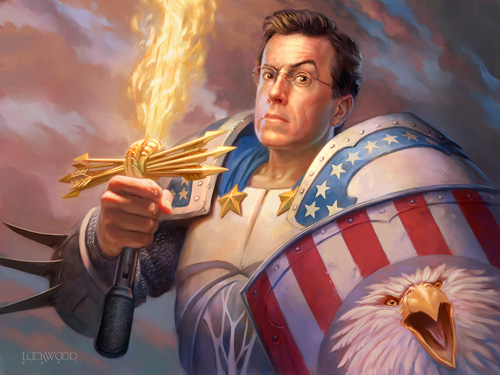
Stephen Colbert, american hero, legend, dare we say it...demigod?
Much thanks to Laughingsquid.com and Nick Douglas for posting this.
-Adam
Stephen Colbert, american hero, legend, dare we say it...demigod?
Much thanks to Laughingsquid.com and Nick Douglas for posting this.
-Adam
Wednesday, February 20, 2008
Finally an MMORPG to be excited about!
Champions MMORPG
Sure, I played D&D back in the 80's, but Champions was MY GAME. It's the last game I played regularly, and I while I could sell my D&D books and not shed a tear, I couldn't stand to lose my beloved Champions books.
I...can't...wait.
-Adam
Sure, I played D&D back in the 80's, but Champions was MY GAME. It's the last game I played regularly, and I while I could sell my D&D books and not shed a tear, I couldn't stand to lose my beloved Champions books.
I...can't...wait.
-Adam
Thursday, February 14, 2008
Zero Punctuation iz da bom!
If you haven't seen Ben "Yahtzee" Croshaw's Zero Punctuation video game reviews, you're missing out. They've become a weekly feature on the Escapist Magazine website and a highlight of my week. New episodes are posted each Wednesday and while the quality of each one is the subject of massive amounts of debate, the fact that they garner such debate is clear evidence of success.
Note: The reviews are wonderfully crass and Yahtzee is not the least bit afraid of using words like F***.
If indeed I still have regular readers (which I sort of doubt) you've probably noticed how I've started talking more and more about video games. Well, I have. There, I said it.
-Adam!!!
Note: The reviews are wonderfully crass and Yahtzee is not the least bit afraid of using words like F***.
If indeed I still have regular readers (which I sort of doubt) you've probably noticed how I've started talking more and more about video games. Well, I have. There, I said it.
-Adam!!!
Life's Little (and Big) Detours
,As of yesterday I no longer work for Hidden City Games. I was laid off in a round of down-sizing that included not just me, but several people including some others who've been working at HCG since the Clout days.
While I'm sad about leaving the best job I've ever had, I'm optimistic I'll be able to get either another game developer job or get my own gaming business off the ground. Both are long-shots, but I've got a little time to explore both options. As these things go, the timing isn't terrible.
I'd also like to publicly thank my dear friends Jesper Myrfors and Paul Peterson who actively worked to keep me on. I know that if it were their decision, I'd still be there, and that means a lot to me.
If any of my Seattle area friends read this blog and need my services, I'm free to do whatever you need done. After working on pink horses for little girls (not a bad thing!), I'm basically ready for anything. Even so, the more robots and zombies, the better.
My HCG e-mail address still works, but I can't say for how long. To reach me, your best bet is conusa <> comcast <> net
-Adam
While I'm sad about leaving the best job I've ever had, I'm optimistic I'll be able to get either another game developer job or get my own gaming business off the ground. Both are long-shots, but I've got a little time to explore both options. As these things go, the timing isn't terrible.
I'd also like to publicly thank my dear friends Jesper Myrfors and Paul Peterson who actively worked to keep me on. I know that if it were their decision, I'd still be there, and that means a lot to me.
If any of my Seattle area friends read this blog and need my services, I'm free to do whatever you need done. After working on pink horses for little girls (not a bad thing!), I'm basically ready for anything. Even so, the more robots and zombies, the better.
My HCG e-mail address still works, but I can't say for how long. To reach me, your best bet is conusa <
-Adam
I can't think of a better way to remember my friend!
Written my other friend, Mike Selinker, on Paizo Publishing's Blog
If you like, you can buy the game there, as well.
-AdamPaul Randles' Final Game: Key Largo
Tuesday, February 12, 2008
In February 2003, Pirate's Cove designer Paul Randles died of cancer. That
story didn't have a happy ending. This one does.
A year earlier, Paul drafted a deep-sea diving board game he called Treasure
Hunt. Players would salvage treasure from shipwrecks off the Florida coast.
The game had pop-up boats, and little cardboard shipwrecks with treasure
disks. Paul wanted a European publisher to publish it, but it wasn't good
enough yet. A solid 6 on the scale of 1 to 10, he said. It better at least
be a 9 before it hit the street.
Then he got sick. I didn't know how to help. My wife did. Evon suggested I
ask Paul for Treasure Hunt. I'd develop the game with him, and then find a
publisher to put it out. For the last months of his life, we worked on the
game together.
I gave him a 21-Nerf-gun salute at his funeral, and told the legions of game
industry folk there that I was shopping Treasure Hunt. It was a pretty good
game by this point. Maybe an 8.
At an Ohio convention, I met Bruno Faidutti, the French designer of
Citadels. He knew of Paul and wanted to help. Within a month he had
restructured the game he was now calling Treasure Island into a great game.
A 9 for sure. Gone were the pop-up boats and the cardboard shipwrecks,
replaced now by full-size boats and card decks of sunken treasure. Now we
could find someone to publish it.
Every publisher wanted to see the game, because Paul had a lot of friends. A
major American board game company wanted to convert it to a dungeon-crawl
game. I thanked them and declined. (Side story: Based on this, I did design
that dungeon game, with my co-designer James Ernest of Cheapass Games. That
game, Dungeonville, came out from two more publishers, Z-Man Games and
Pegasus Spiele. So Paul's game has a son, and he's bilingual.)
Then Tilsit Editions of France made an offer, which Bruno, Paul's widow
Katty, and I accepted. Editor Nicolas Anton proposed adding people you could
meet on the island, the last thing the game needed to become a 10 out of 10.
Tilsit renamed it Key Largo, gave it a fancy cover and a modular board, and
released it in 2005 in German, Italian, and French. Which was great, except
I don't speak any of those languages very well.
But I do speak English, and I do know Lisa Stevens, the CEO of Paizo
Publishing. Lisa was looking to start a new line of board games, which
eventually I helped forge into Titanic Games, the publisher of the color
version of Kill Doctor Lucky and Stonehenge: An Anthology Board Game.
Titanic needed a third game, so I looked at the name of the company and
said, "How about one about sinking ships?"
How about it indeed, she said. And so, in February 2008, five years to the
month after Paul's passing, Titanic Games will be releasing the full-color
English version of Key Largo, with all-new art and all-new components
delivered by graphic designer James Davis. The English edition has a large
one-piece board, nice wooden boats, fifteen delightful divers, and beautiful
cards with art from Ben Huen and Andrew Hou. Everyone we've shown it to says
it's a work of art. I like those people.
The game has undergone a lot of facelifts since Paul's fun little prototype,
but there's something unmistakably Paul-ish in the final version. That's why
the money in the game bears the inscription "E Paulibus Unum," which I can
pretend means "In Paul We Trust."
I can't play Key Largo with Paul, but now I can play it with you.
Mike Selinker
Tuesday, January 29, 2008
Endless Ocean again? - This time a real review.
,Wildcard’s Score Card - Endless Ocean

Overview
Endless Ocean is a leisurely paced exploration game for the Wii. While there are certainly tasks offered up for the player to complete, most of my sessions have been spent simply swimming around, looking for new fish, seascapes, and hidden treasures.
Strong Points
The seascape and creature design is fabulous. It’s very easy to let yourself be immersed in the game, focusing on its beauty and serenity. As been pointed out in every review, both positive and negative, the game is extremely tranquil and relaxing. What’s more exciting to me is how different Endless Ocean is from standard game fair. Somebody took a big risk with this, but the Wii’s casual audience and Nintendo’s commitment to providing unique casual gaming experiences created a perfect situation for a game like this to flourish. On a previous gen system, titles like this would be released and whither into obscurity, but on the Wii it has surfaced as a potential hit…or at least cult hit. I purchased it specifically because I wanted to support these sorts of games. I’ve spent the last four nights playing nothing else because the game is so darned good.
Weak Points
While the graphics are gorgeous, they are limited by the Wii’s power, and occasionally something will look awkward or move poorly. Because the game focuses totally on the experience issues like these that would be nothing on a standard action-type game are distracting in this one. The above water graphics are relatively crude, but also irrelevant. Your human partner in the game, a biologist character, has some personal issues in the storyline which I found annoying. In a game that is essentially stress-free, having an in-game character with personal problems was distracting to me. You have to ‘talk’ to her to find out what’s next in the story-line missions, but after a short while, I really didn’t want to. While I wasn’t talking to her, the plot-line (unessential as it is) stalled and I found myself getting bored with the game. Once I realized what I needed to do next, the enjoyment level jumped back up again.
Audience
Anyone who has complained that video games are in a rut, recycling the same ideas over and over again, should check out Endless Ocean. That said, it isn’t for everyone. It’s obviously a casual game, so people who only like high-octane action/strategy-fests will find little to stimulate them. For those of us who enjoy more sedate experiences, Endless Ocean delivers exactly what it promises. In other words, if you think you’ll like it, I think you’ll love it.
Wrap Up
Endless Ocean is a bargain title at only $30. I’m hoping it’s a hit so more EO titles, with enhanced graphics and even larger areas to explore are released, and more games like EO are created. This game, rendered with the power of an Xbox360 or a PS3 would be unbelievable. Even on the Wii, it’s wonderful and remarkable. What shortcomings the game does have are largely unrelated to the core activity – exploring an amazing undersea world. While they lower the scores on mainstream game media reviews, they have very little impact on the overall game experience.
Grade: A
Sunday, January 27, 2008
Game Submission Guidelines
Most game designers would like to design their game, show it to a publisher, and let the money start rolling in. Everyone knows it doesn't really work like that (except for me, one time) but it's still how we all wish it would work.
I think the future of game publishing, from a designer's point of view, is in self publishing. It's a lot harder than the 'fire and forget' system of getting an established publisher to make your game, but your chances for success are vastly, VASTLY, improved.
If you ignore those odds and want to submit a game anyway I suggest the following:
In all honesty, it doesn't hurt to try and get feedback from companies on your games, even if you know they aren't going to publish it. The more comments from people outside your circle of friends, the better your game will be. If you can, take it to conventions and try it out there (easier said than done, I know.)
Hobby game designers have this notion that their ideas are special and that if too many people see it, the idea will be stolen. For the most part, that's rubbish. The more people that see your ideas the more valuable feedback you're likely to get. Also, everyone thinks their ideas are better than yours, so stealing ideas isn't on most people's to-do list. The best way to prove them wrong is to turn your idea into a reality. That's where the value is.
-Adam!!!
I think the future of game publishing, from a designer's point of view, is in self publishing. It's a lot harder than the 'fire and forget' system of getting an established publisher to make your game, but your chances for success are vastly, VASTLY, improved.
If you ignore those odds and want to submit a game anyway I suggest the following:
- Make sure your prototype is ready to play*. If I can't play it, I can't evaluate it properly.
- Make it look nice. Art isn't required, but clip art is easy, free and will add a lot to the presentation.
- Don't go crazy with art. Art directors will always want to redo everything anyway.
- Do go crazy with rules. Clear as crystal. Keep typos to a minimum. This isn't a resume', so a lone spelling error shouldn't disqualify you. That said, if it's too hard to read or we can't figure it out, we're not interested.
- Don't worry about marketing, pricing, or presentation. Like art directors, marketing and sales directors have there own ideas about those sorts of things.
In all honesty, it doesn't hurt to try and get feedback from companies on your games, even if you know they aren't going to publish it. The more comments from people outside your circle of friends, the better your game will be. If you can, take it to conventions and try it out there (easier said than done, I know.)
Hobby game designers have this notion that their ideas are special and that if too many people see it, the idea will be stolen. For the most part, that's rubbish. The more people that see your ideas the more valuable feedback you're likely to get. Also, everyone thinks their ideas are better than yours, so stealing ideas isn't on most people's to-do list. The best way to prove them wrong is to turn your idea into a reality. That's where the value is.
-Adam!!!
Wednesday, January 23, 2008
Endless Ocean - If it's fun, I guess it's a game.
It's rare that I purchase a game for my Wii on impulse, yet when I simultaneously read about Endless Ocean on Kotaku's new release post and Penny Arcade's Blog I decided I like the look of it and I wanted it.
Endless Ocean is a scuba diving simulation. Good God, it is sooooooo relaxing.
Conflict - None
Danger - None
Difficulty - Easy
Pace - Slooooooooooow
Graphics - Purty
What do you do in the game? You swim. You look for things. "Missions" consist of people asking (nicely, with no obligations) you to help them find specific things. No hurry, just if you feel like it.
In my first few hours of play I:
* Saw and swam with a whale
* Helped a dolphin stuck in a lagoon, it became my friend.
* Found a lost medal and part of an old compass on the sea floor.
* Swam with hammerheads.
* Saw sharks, not the hammerheads, spawn (I guess, they mostly just sat there.)
* Helped two tourists find a particular fish they liked.
* Populated an aquarium tank with fish I'd discovered.
* Petted three kinds of penguins.
* Stayed up nearly an hour later than normal because I didn't want to stop playing.
My current unfinished 'task' is to take a picture of a particular fish...a blue something. No problem, they're pretty common.
Does that sound boring to you? Some people find it boring. Heck, after a couple more hours I might find it boring. For now, however, I find it memorizing and I've spent all day at work just waiting to get back home to it.
One last feature, it's only $30.
-Adam!!!
Endless Ocean is a scuba diving simulation. Good God, it is sooooooo relaxing.
Conflict - None
Danger - None
Difficulty - Easy
Pace - Slooooooooooow
Graphics - Purty
What do you do in the game? You swim. You look for things. "Missions" consist of people asking (nicely, with no obligations) you to help them find specific things. No hurry, just if you feel like it.
In my first few hours of play I:
* Saw and swam with a whale
* Helped a dolphin stuck in a lagoon, it became my friend.
* Found a lost medal and part of an old compass on the sea floor.
* Swam with hammerheads.
* Saw sharks, not the hammerheads, spawn (I guess, they mostly just sat there.)
* Helped two tourists find a particular fish they liked.
* Populated an aquarium tank with fish I'd discovered.
* Petted three kinds of penguins.
* Stayed up nearly an hour later than normal because I didn't want to stop playing.
My current unfinished 'task' is to take a picture of a particular fish...a blue something. No problem, they're pretty common.
Does that sound boring to you? Some people find it boring. Heck, after a couple more hours I might find it boring. For now, however, I find it memorizing and I've spent all day at work just waiting to get back home to it.
One last feature, it's only $30.
-Adam!!!
Tuesday, January 22, 2008
Spectromancer Beta
For all you PC users out there (sorry, no mac version) Hidden City Games has just released its latest computer game offering for beta testing.
Check out - Enjoy!
-Adam
Check out - Enjoy!
-Adam
Monday, January 14, 2008
Hasbro is at it again...Cease and Desist!
Hasbro is threatening to shut down one of my favorite online activities, Scrabulous from Facebook.
I believe this is Hasbro shooting themselves in the virtual foot, once again. The idea, it seems, is to use legal pressure to remove Scrabulous from the picture so their online version/s of Scrabble don't have the competition.
There's no point in arguing whether or not they can do this. Of course they can. I will continue to argue that they SHOULDN'T. I believe:
* Scrabulous increases the number of Scrabble players in the world, and Hasbro directly benefits from this.
* Hasbro's 'official' Scrabble game should be good enough to make people switch, if is a zero-sum situation. If it's not good enough, it'll fail with or without Scrabulous in the picture.
* Evergreen games like Scrabble, Monopoly, Yahtzee, ect. are going to be more and more difficult to 'own' as more and more fans want to play online. In place of an official version, these home-grown efforts (both for profit and not) are going to keep popping up.
* I play Scrabulous because it's a Facebook app. If Hasbro's isn't and I really doubt it would be, then I'll simply find another free game to play on Facebook and never think about Scrabble again (which I hadn't for years before I started playing Scrabulous.)
-Adam!!!
I believe this is Hasbro shooting themselves in the virtual foot, once again. The idea, it seems, is to use legal pressure to remove Scrabulous from the picture so their online version/s of Scrabble don't have the competition.
There's no point in arguing whether or not they can do this. Of course they can. I will continue to argue that they SHOULDN'T. I believe:
* Scrabulous increases the number of Scrabble players in the world, and Hasbro directly benefits from this.
* Hasbro's 'official' Scrabble game should be good enough to make people switch, if is a zero-sum situation. If it's not good enough, it'll fail with or without Scrabulous in the picture.
* Evergreen games like Scrabble, Monopoly, Yahtzee, ect. are going to be more and more difficult to 'own' as more and more fans want to play online. In place of an official version, these home-grown efforts (both for profit and not) are going to keep popping up.
* I play Scrabulous because it's a Facebook app. If Hasbro's isn't and I really doubt it would be, then I'll simply find another free game to play on Facebook and never think about Scrabble again (which I hadn't for years before I started playing Scrabulous.)
-Adam!!!
Monday, December 17, 2007
Positive Reinforcement
I'm a big fan of the PS2 games Katamari Damacy and I [heart] Katamari. It occurs to me, particularly in the sequel, the game is filled with characters egging you on and challenging you to do well. Other games, such the Pokemon RPG games, also have lot of characters that reinforce the notion that what you're doing is worthwhile. I think more games, particularly American games, could stand to have a bit more of that. When I'm spending hours at a time collecting arbitrarily large quantities of gems, or sparkles, or whatever, the more NPCs that come over and tell me how great I am for doing all this work, the better.
-Adam!!!
-Adam!!!
Monday, October 15, 2007
MMO, the Next Generation
World of Warcraft - Huge. Why? It's just Everquest, but better. Well, it is (was) the next generation of MMO. There was a gap between EQ and EQ2 and WoW jumped in there right when EQ aged and lost traction and EQ2 hadn't caught on (for a variety of reasons.)
There will be a time when WoW no longer holds up. Will WoW2 replace it, or will a new game by a new developer fill the gap? My guess is that Blizzard and every other developer who wants to release an MMO is working to identify that gap, and hit it with the best product they can. Blizzard's goal is to make that gap as short as possible, reducing competition's chance to wedge themselves in there. They've got a huge advantage...just like Sony and Everquest did.
I'm curious to see what supplants WoW. I'm glad I don't work for a company who's trying to shoot that gap (besides Blizzard, at least.)
Other sure fire hits: New Coke, Playstation 3, Everquest 2, and Godfather part III.
Most people are only going to pay $15 per month for one game. The best game. "Best", however, is defined by a lot of factors, many external to the game itself.
-Adam!!!
There will be a time when WoW no longer holds up. Will WoW2 replace it, or will a new game by a new developer fill the gap? My guess is that Blizzard and every other developer who wants to release an MMO is working to identify that gap, and hit it with the best product they can. Blizzard's goal is to make that gap as short as possible, reducing competition's chance to wedge themselves in there. They've got a huge advantage...just like Sony and Everquest did.
I'm curious to see what supplants WoW. I'm glad I don't work for a company who's trying to shoot that gap (besides Blizzard, at least.)
Other sure fire hits: New Coke, Playstation 3, Everquest 2, and Godfather part III.
Most people are only going to pay $15 per month for one game. The best game. "Best", however, is defined by a lot of factors, many external to the game itself.
-Adam!!!
Saturday, October 13, 2007
How much would you pay for this game?
If you follow any of the popular news-feeds you know that Radiohead just released a new album and they're selling it for whatever their fans want to pay, including nothing. It seems most people are shelling about between $5 and $9 (based on a poll, I think) and that sounds about right. I'm not a Radiohead fan so if I get it, I'll be doing it the freeloader way. Why is that a good deal for Radiohead? Well, there's no way I'd pay for music I'm not sure I'd like, and if I do like it, who knows what I might pay for in the future?
I love the idea of download-able games. Games you can print and play on an inkjet printer. The logistics have stymied me for about a year now, but I keep my eyes open for technology that'll make printing on demand or printing at home an affordable and attractive alternative to traditional game manufacturing and distribution.
What if you could download PDFs of out of print card games (both traditional and collectible). How much would you pay? What if you owned the rights to some of these games? How much would it take to make them available in this manner?
-Adam!!!
I love the idea of download-able games. Games you can print and play on an inkjet printer. The logistics have stymied me for about a year now, but I keep my eyes open for technology that'll make printing on demand or printing at home an affordable and attractive alternative to traditional game manufacturing and distribution.
What if you could download PDFs of out of print card games (both traditional and collectible). How much would you pay? What if you owned the rights to some of these games? How much would it take to make them available in this manner?
-Adam!!!
Tuesday, October 09, 2007
It's a Bird, It's a Plane!
Super-Fans
Most games have them. All successful games do. The Super-Fan. The 1%ers. The folks that are REALLY, REALLY into it.
Super-Fans build fan sites, some so elaborate they rival (or best) the publisher's site.
Super-Fans participate in on-line forum discussions, chats, and blogs. If the publisher doesn't host such things, the super-fans start their own.
Super-Fans buy EVERYTHING, and often more so their friends (or local deserving kids) can have your game too.
Super-Fans volunteer at conventions and run local events. (If you help them, sometimes even if you don't.)
If your Super-Fan owns a store, it's probably a top seller of your game. (With Clout, the stores where the managers/owners loved the game sold piles of chips. Unfortunately, there weren't near enough of those stores!)

The key to getting the most out of Super-Fans is to understand why they are Super Fans (beyond you're game being awesome, I mean.) Like most people, they like being a part of something, and you're lucky enough that they chose you're game community to be a part of. What do they want in return?
Stuff? Sure, but not really.
Appreciation? Yes.
Recognition? Absolutely!
The inside scoop? Hells Yes.
Super-Fans want you to know who they are and they want to be a part of what you're doing.
Everything you can do to make being a super-fan an easier thing to be, will pay dividends. They'll have an awesome time, you'll sell a lot of games. In the game industry it means having communities tools in place. It means having customer service and/or organized play people that communicate two-way. Super-fans put forth extra effort. It's your job to recognize that. Shouting at them through boilerplate, press releases, and ads is NOT communicating. That sort of thing is for the customers, maybe the regular fans, NOT the Super-Fans.
Are Super-Fans worth it? Of course. Even if you're really into the games you're making, they're more into it. With TCG's, the average Super-Fan knows more about the games than the average employee at the company publishing the game (a fact many Super-Fans I've met don't like, but hey, it's their passion vs. our job!)
Also, Super-Fans are awesome to hang around with at conventions!
-Adam!!!
Most games have them. All successful games do. The Super-Fan. The 1%ers. The folks that are REALLY, REALLY into it.
Super-Fans build fan sites, some so elaborate they rival (or best) the publisher's site.
Super-Fans participate in on-line forum discussions, chats, and blogs. If the publisher doesn't host such things, the super-fans start their own.
Super-Fans buy EVERYTHING, and often more so their friends (or local deserving kids) can have your game too.
Super-Fans volunteer at conventions and run local events. (If you help them, sometimes even if you don't.)
If your Super-Fan owns a store, it's probably a top seller of your game. (With Clout, the stores where the managers/owners loved the game sold piles of chips. Unfortunately, there weren't near enough of those stores!)

At the Tangled Web, Clout tournaments were huge. The manager was a super-fan.
The key to getting the most out of Super-Fans is to understand why they are Super Fans (beyond you're game being awesome, I mean.) Like most people, they like being a part of something, and you're lucky enough that they chose you're game community to be a part of. What do they want in return?
Stuff? Sure, but not really.
Appreciation? Yes.
Recognition? Absolutely!
The inside scoop? Hells Yes.
Super-Fans want you to know who they are and they want to be a part of what you're doing.
Everything you can do to make being a super-fan an easier thing to be, will pay dividends. They'll have an awesome time, you'll sell a lot of games. In the game industry it means having communities tools in place. It means having customer service and/or organized play people that communicate two-way. Super-fans put forth extra effort. It's your job to recognize that. Shouting at them through boilerplate, press releases, and ads is NOT communicating. That sort of thing is for the customers, maybe the regular fans, NOT the Super-Fans.
Are Super-Fans worth it? Of course. Even if you're really into the games you're making, they're more into it. With TCG's, the average Super-Fan knows more about the games than the average employee at the company publishing the game (a fact many Super-Fans I've met don't like, but hey, it's their passion vs. our job!)
Also, Super-Fans are awesome to hang around with at conventions!
-Adam!!!
Monday, October 08, 2007
Boxes, Little Boxes
Before I spout about Super-Fans (the most important 1% of your customer base) I think I'll digress a bit.
Adam, how can you put all these people in broad categories? Well, of course, I can't. This isn't about individuals. Ideally, you should make decisions about your games that meet the needs of each individual customer, individually. If Allen from Wichita needs large type, and you could get it for him, you'd sell a game to Allen. Barney wants a cheap game and doesn't care about color or fancy graphics. Teresa not only wants high quality art, but she's an artist and wants a way to include her art in the game. Sadly, that's just not possible (yet.) You can't please everyone. Also, you can't choose who's going to like your game. That's their choice. What can you do? You can choose who YOU WANT to please, and you can make decisions based on that. If you don't choose, you're leaving it all up to luck. I don't recommend that. (Making a game for people who are just like you is a choice, and it can be a fine one, if you're cool enough. =-)
It's not just acquisition and retention. That's too simple. It's essential, but not adequate. That doesn't cover fans, and fans are the most important element to the success of a game. You can't just target fans, either, because they people don't start as fans. If you go up to a stranger on the street and say "join my fan club, you'll get special content nobody else can get." your success rate will be dismal. If you ask a customer who's just made their first purchase that same question, you'll find a slightly more receptive audience. If you ask somebody who buys everything you make, the response will overwhelmingly positive. Ask the right people the right questions. Give the right people the right benefits. That's all I'm saying.
-Adam!!!
Adam, how can you put all these people in broad categories? Well, of course, I can't. This isn't about individuals. Ideally, you should make decisions about your games that meet the needs of each individual customer, individually. If Allen from Wichita needs large type, and you could get it for him, you'd sell a game to Allen. Barney wants a cheap game and doesn't care about color or fancy graphics. Teresa not only wants high quality art, but she's an artist and wants a way to include her art in the game. Sadly, that's just not possible (yet.) You can't please everyone. Also, you can't choose who's going to like your game. That's their choice. What can you do? You can choose who YOU WANT to please, and you can make decisions based on that. If you don't choose, you're leaving it all up to luck. I don't recommend that. (Making a game for people who are just like you is a choice, and it can be a fine one, if you're cool enough. =-)
It's not just acquisition and retention. That's too simple. It's essential, but not adequate. That doesn't cover fans, and fans are the most important element to the success of a game. You can't just target fans, either, because they people don't start as fans. If you go up to a stranger on the street and say "join my fan club, you'll get special content nobody else can get." your success rate will be dismal. If you ask a customer who's just made their first purchase that same question, you'll find a slightly more receptive audience. If you ask somebody who buys everything you make, the response will overwhelmingly positive. Ask the right people the right questions. Give the right people the right benefits. That's all I'm saying.
-Adam!!!
Fanatics, gotta love 'em!
Fans
It's likely that fans are your most important customers. Unlike normal customers, who may like your products and may purchase again, fans DO like your products and WILL purchase again (assuming you have other products to purchase.) This is great news, but they still need care. Special care, at that.
Fans understand you and your products. They assume you understand them in return. This may or may not be the case, depending on whether or not you stumbled across something they like (luck) or sought them out (strategy.) If you lucked into a successful product that gathered an unexpected fan-base, you better listen extra close to what they say. The chance of that luck holding out is slim. If you've gathered your fan-base with successful strategy, chances are you're more in the ball-park, but you still better listen to what they say. Listen, and act where you can based on Fan input.
Fans, unlike normal customers, have an emotional investment (as well as financial) in your product and/or company. Your success reflects well upon their choices, so they want to see you succeed. They also want more of whatever it is you do, because they like it. It's all good.
If you don't succeed, some fans will turn on you (regular customers don't care enough to), which is part of the emotional aspect of fandom. Working for Wizards, we canceled a lot of products, and it was always rough. When Clout ended, I was totally surprised at the positive reaction from our fans. They were upset, of course, but unlike Wizards fans, Clout fans knew we didn't have choice about whether to keep kicking the Clout horse or letting it go. It's not mindless emotion, gamers are smart people. Treat people right and it you'll be surprised how it comes back to you (often in unexpected ways!)
As I've written before (Viral, Hardcore, or Vanish), if you've sold any games at all, you've always got fans. When you're struggling, all of your customers are fans. They're often the first to arrive (early adopters) and the last to leave. If you have enough fans, you're bound to succeed, even if your game is never a huge hit.
Because fans are so important, and such a powerful part of your customer-base, I think it's essential to communicate to normal customers how they can become fans. Reward them for fan-like behavior. Make being a fan significantly cooler than being just a customer. I don't know how, exactly, it's YOUR game. =-)
Next: Super-Fans
-Adam!!!
It's likely that fans are your most important customers. Unlike normal customers, who may like your products and may purchase again, fans DO like your products and WILL purchase again (assuming you have other products to purchase.) This is great news, but they still need care. Special care, at that.
Fans understand you and your products. They assume you understand them in return. This may or may not be the case, depending on whether or not you stumbled across something they like (luck) or sought them out (strategy.) If you lucked into a successful product that gathered an unexpected fan-base, you better listen extra close to what they say. The chance of that luck holding out is slim. If you've gathered your fan-base with successful strategy, chances are you're more in the ball-park, but you still better listen to what they say. Listen, and act where you can based on Fan input.
Fans, unlike normal customers, have an emotional investment (as well as financial) in your product and/or company. Your success reflects well upon their choices, so they want to see you succeed. They also want more of whatever it is you do, because they like it. It's all good.
If you don't succeed, some fans will turn on you (regular customers don't care enough to), which is part of the emotional aspect of fandom. Working for Wizards, we canceled a lot of products, and it was always rough. When Clout ended, I was totally surprised at the positive reaction from our fans. They were upset, of course, but unlike Wizards fans, Clout fans knew we didn't have choice about whether to keep kicking the Clout horse or letting it go. It's not mindless emotion, gamers are smart people. Treat people right and it you'll be surprised how it comes back to you (often in unexpected ways!)
As I've written before (Viral, Hardcore, or Vanish), if you've sold any games at all, you've always got fans. When you're struggling, all of your customers are fans. They're often the first to arrive (early adopters) and the last to leave. If you have enough fans, you're bound to succeed, even if your game is never a huge hit.
Because fans are so important, and such a powerful part of your customer-base, I think it's essential to communicate to normal customers how they can become fans. Reward them for fan-like behavior. Make being a fan significantly cooler than being just a customer. I don't know how, exactly, it's YOUR game. =-)
Next: Super-Fans
-Adam!!!
Wednesday, October 03, 2007
The People Who are Always Right
Customers
So you've made a sale. Whew! The hard work is over.
You wish.
Customers are great. They make up a huge segment of the buying population, but we make games. We don't need just customers, because odds are you'll never reach enough people to survive selling just one booster pack, starter set, or game (unless the game's really expensive...still, you're not making those expansions for your health!)
Just like Tourists, you have to treat you Customers right. In fact, the very fact they've put down some hard earned cash means their attention is focuses squarely on you, what you are selling, and how you support it. Unlike Tourists, customers really care about what they're getting. They've put their toe in the pool and now it's up to you to make sure it's the right temperature.
Is it?
If it is, some of your customers will become what you really want. What you really need. They will become FANS.
Next: Fans.
-Adam!!!
So you've made a sale. Whew! The hard work is over.
You wish.
Customers are great. They make up a huge segment of the buying population, but we make games. We don't need just customers, because odds are you'll never reach enough people to survive selling just one booster pack, starter set, or game (unless the game's really expensive...still, you're not making those expansions for your health!)
Just like Tourists, you have to treat you Customers right. In fact, the very fact they've put down some hard earned cash means their attention is focuses squarely on you, what you are selling, and how you support it. Unlike Tourists, customers really care about what they're getting. They've put their toe in the pool and now it's up to you to make sure it's the right temperature.
Is it?
If it is, some of your customers will become what you really want. What you really need. They will become FANS.
Next: Fans.
-Adam!!!
Tuesday, October 02, 2007
Giveitaway Giveitaway Giveitaway NOW!
Tourists
Does your game company give things away for free? I bet it does.
Who are the people who download your demo, and play it over and over again?
Who are the people who play your website's free web games?
Who are the people that scour the convention floor for freebees?
And they haven't bought ANYTHING!
They are Tourists, and one of the best ways to get their attention is with free stuff. What you do with that attention, is up to you.
Some Tourists will never buy anything, no matter what you do. That's okay. Treat them right, but don't let them get in the way of potentials. The people who are interested in what you're selling. With them, you have their attention, you have something they're interested in. Now what?
That, of course, depends. We're selling trading cards. I think the biggest hurdle with a trading card product is making that first sale. That's a major threshold moment in your relationship with that person. That first sale elevates the person from Tourist to Customer. Everything Changes.
All your customers start out as tourists. The attention you get depends on how interesting you are to look at. What you can do with their attention determines how many become customers.
Next: Customers
-Adam!!!
Does your game company give things away for free? I bet it does.
Who are the people who download your demo, and play it over and over again?
Who are the people who play your website's free web games?
Who are the people that scour the convention floor for freebees?
And they haven't bought ANYTHING!
They are Tourists, and one of the best ways to get their attention is with free stuff. What you do with that attention, is up to you.
Some Tourists will never buy anything, no matter what you do. That's okay. Treat them right, but don't let them get in the way of potentials. The people who are interested in what you're selling. With them, you have their attention, you have something they're interested in. Now what?
That, of course, depends. We're selling trading cards. I think the biggest hurdle with a trading card product is making that first sale. That's a major threshold moment in your relationship with that person. That first sale elevates the person from Tourist to Customer. Everything Changes.
All your customers start out as tourists. The attention you get depends on how interesting you are to look at. What you can do with their attention determines how many become customers.
Next: Customers
-Adam!!!
Subscribe to:
Posts (Atom)